Play Spades
Bid your tricks, keep spades as trump, and race to the target. Play Partnership Spades against a sharp computer table - or take a friend head-to-head in real-time multiplayer. No download, no signup.Spades.now is a free online home for the classic trick-taking card game, built around Partnership Spades and rounded out with cutthroat Solo, forced-bid Whiz and six more variants. Call your bid, cover your partner, dodge the sandbags, and go make your contract - against the computer, on a single shared daily deal, or live against a friend in multiplayer. There's nothing to install and no account required: sort your hand and bid below.
Other games worth playing
How Partnership Spades works
The short version: The classic four-player game - Bid tricks with your partner and make good on the promise. You play with four players in two fixed partnerships (you and north vs west and east), using one standard 52-card deck, dealt thirteen to a hand, and it is easy to learn, a lifetime to master.
Partnership Spades is the version almost everyone means when they say "Spades": four players, two teams sitting across from each other, and a shared promise to win a set number of tricks each hand. Spades are always trump, so the humble suit that gives the game its name beats every heart, diamond and club on the table. You and your partner each bid the number of tricks you expect to take, add those bids together, and then try to land exactly on that total - No more and no less. The magic of the game lives in that partnership. You never see your partner's cards, yet every lead, every trump and every discard is a quiet message about what you hold and what you need. Bid too high and you go "set," losing ten points for every trick you promised. Bid too low and you rack up penalty bags. Threading that needle, hand after hand, is what keeps players coming back to Spades for a lifetime.
Spades at the table
| Object of the game | Team up with the player across the table. Each hand, you and your partner promise a number of tricks and try to take exactly that many. The first partnership to the target score wins the match. |
|---|---|
| Players | Four players in two fixed partnerships (you and North vs West and East) |
| Cards | One standard 52-card deck, dealt thirteen to a hand |
| How you win the match | First partnership to reach the target score wins the match |
| Score targets | Race to 250, Marathon to 500 |
| Luck vs skill | Mostly skill - Accurate bidding and card counting decide most matches |
| Family | Classic |
A hand of Spades, step by step
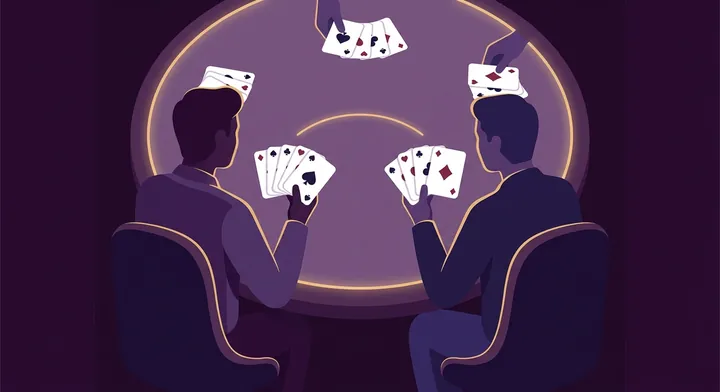
Goal
Team up with the player across the table. Each hand, you and your partner promise a number of tricks and try to take exactly that many. The first partnership to the target score wins the match.
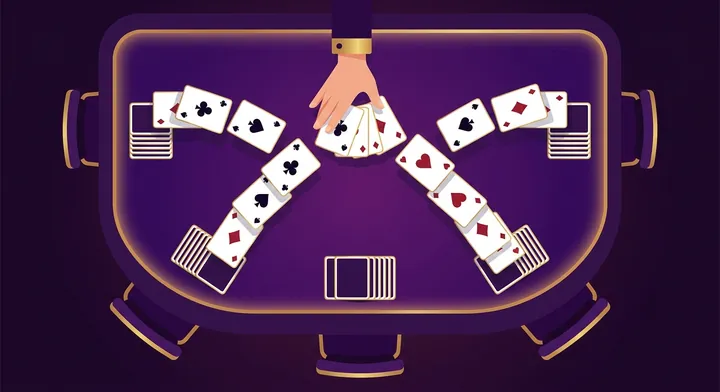
The deal
The whole 52-card deck is dealt out, thirteen cards to each of the four players. There is no stock and no kitty - Every card is in someone's hand.

Bidding
Starting to the dealer's left, each player calls how many of the thirteen tricks they think they can win, from 0 (a Nil) up to 13. Your bid and your partner's bid add together into one team contract.

Playing a trick
The player left of the dealer leads any card except a spade. Everyone must follow the led suit if they can. Spades are trump: a spade beats any card of another suit, and the highest card wins the trick and leads the next one.
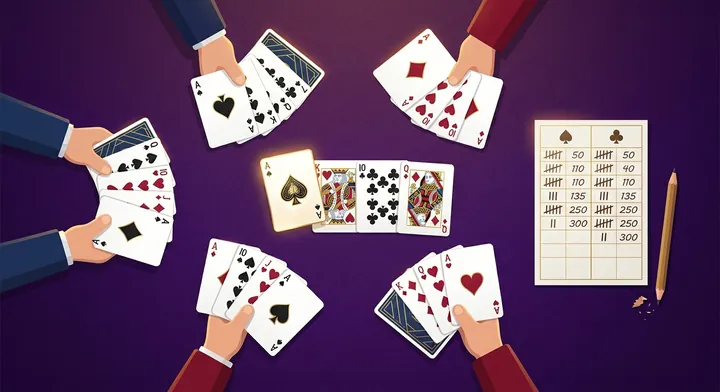
Scoring
Make your team's combined bid and score ten points per trick bid, plus one point per extra trick as a 'bag'. Miss the bid and you are 'set', losing ten points per trick bid. Collect ten bags and you are docked 100 points.
Where Spades comes from
Spades is a young game by card-game standards. It was invented in the United States around 1937 and spread quickly through the 1940s, when soldiers in the Second World War taught it to one another in barracks and foxholes because a hand could be interrupted and resumed easily - Ideal for players who might be called away at any moment.
After the war those soldiers carried Spades home, and it took especially deep root on American college campuses and in African American communities, where it became a social institution: a game played loudly, competitively and for hours at a kitchen table. The trash talk, the table rules and the fierce loyalty between partners all grew out of that culture.
The game exploded again in the internet era. Early online services and Windows bundled a Spades client, and it became one of the most-played card games in the world, second only to a handful of casino games. Today Partnership Spades is the anchor of a whole family of variants, from cutthroat solo play to joker-laden high-scoring versions, all built on the same simple promise: bid your tricks, then go make them.
Winning Spades: bidding & play
♠ Table wisdom: Count your sure winners before you bid: high spades, aces, and protected kings are tricks in the bank, while long side suits and low spades are only maybes.
The tips that move the score the most
- Lead your partner's strength, not just your own. Once you sense which suit they are long in, feed it to them so their small trumps and length can score.
- Hold your high spades back early. Spending the ace of spades on the first round wastes it - Save it to grab a trick the opponents actually want.
- Watch the bags. If your side is already flirting with a 100-point sandbag penalty, deliberately duck tricks you do not need rather than piling on overtricks.
- Support a partner's Nil above your own overtricks. When your partner bids Nil, your job is to cover them by winning the tricks they cannot, even at the cost of a bag or two.
- Track which suits are 'out'. The moment an opponent shows they are void in a side suit, expect them to trump it, and steer your leads elsewhere.
- Bid the hand in front of you, not the score you wish you had. Chasing a comeback with a wild ten-bid usually just hands the other team a fat set.
Advanced Spades tactics
- Re-count the hand after the bids are in. The sum of all four bids tells you how many tricks are 'spoken for' and how many are loose; a low total means overtricks and bags are coming, while a high total warns that someone is likely to be set.
- Lead through strength and up to weakness. Leading a suit the player on your left is strong in lets your partner play last and capture the trick, while a suit their right is weak in is safer to develop.
- Manage your spades as a budget. Note roughly how many trumps remain outstanding and try to draw the opponents' spades on your terms, so their small trumps cannot steal your side-suit winners late in the hand.
- When defending against a Nil, attack it early. Lead low in suits where the Nil bidder must eventually win a trick, forcing the bust before their partner can safely dump losers on them.
- Protect your own Nil by planning your discards from the first trick. Keep your lowest cards in the suits opponents are likely to lead, and shed dangerous middle cards whenever a trick is safely won by someone else.
- Read the bag math both ways. If the opponents are near a sandbag penalty, force overtricks onto them; if you are, take exactly your bid and throw the rest away deliberately.
- Save a boss trump for the endgame. Holding the last high spade lets you dictate the final tricks, break a stubborn opponent's suit, or make a game-clinching trick that a spent hand could never manage.
Spades mistakes that cost you points
- Padding your bid to look brave - Getting set costs ten points a trick, so bid the tricks you can actually see, not the ones you are hoping for.
- Blowing your ace of spades on the first round - Save your high trumps to capture a trick the opponents genuinely want rather than wasting them on an early throwaway lead.
- Ignoring your partner's Nil - When your partner bids zero, covering their unavoidable tricks matters more than your own overtricks, so play high to take the danger away.
- Grabbing every overtrick you can - Each extra trick is a bag, and ten bags cost 100 points, so duck the tricks you do not need once your bid is safe.
Ways to play Spades
Play to 250 or 500
The target score sets the length of the match. A game to 250 is a brisk four-to-six-hand session, while the traditional target of 500 rewards long-haul consistency and lets an early set be clawed back.
Nil and Blind Nil
Standard Nil promises zero tricks for a 100-point swing. Blind Nil, declared before you even look at your hand, doubles the stakes to 200 and is usually reserved for teams that are far behind and need a gamble.
Sandbag penalty size
Most games dock 100 points for every ten bags, but some house rules use a smaller penalty or none at all. A harsher bag rule pushes players toward precise bidding; a softer one encourages greedy overtrick grabs.
Solo (Cutthroat) Spades
Drop the partnerships and every player bids and scores for themselves. It is the same core game with very different politics, since no one is obligated to help you make your bid.
Joker Joker Deuce Deuce
Add two jokers as the highest trumps and remove two low cards for a faster, higher-scoring 54-card game that is a fixture of tournament and street play.
Spades questions, answered
How many tricks are there in a hand of Spades?
Thirteen. The full 52-card deck is dealt evenly to four players, thirteen cards each, and every card played goes into one of thirteen tricks. Your bid is simply how many of those thirteen tricks you expect your side to win.
Why are spades always trump?
That is the defining rule of the game and the reason for its name. Any spade, even the two, beats the highest card of hearts, diamonds or clubs. Because trump is fixed, a big part of the skill is knowing when to spend your spades and when to save them.
Can I lead a spade whenever I want?
No. Spades must be 'broken' first - Someone has to play a spade on a trick where they could not follow the led suit. Only after spades are broken (or when a player has nothing but spades left) may a spade be led to a new trick.
What happens if my team wins fewer tricks than we bid?
Your team is 'set'. You lose ten points for every trick you bid - So a bid of five that only wins four costs you fifty points. Getting set is the single biggest swing in Spades, which is why disciplined bidding matters so much.
What are bags in Spades?
Bags, also called sandbags or overtricks, are the tricks you win beyond your bid. Each one is worth a single point now, but they carry a hidden cost: every time your running total of bags reaches ten, you are penalized 100 points and your bag count drops by ten.
Do partners share one bid or bid separately?
Each partner announces their own bid, then the two are added into a single team contract. If you bid four and your partner bids three, your team must win at least seven tricks together to make the contract; it does not matter which partner wins which trick.
What is a Nil bid?
A Nil is a bid of zero: you promise to win no tricks at all. Making it is worth a bonus (usually 100 points), but taking even one trick busts the Nil for the same penalty. Nil turns a weak-looking hand of low cards into a scoring opportunity.
How do you win the whole game, not just a hand?
You play hand after hand, adding each hand's score to a running total, until one partnership reaches the agreed target - Commonly 250 or 500 points. Because a single set can cost fifty points or more, the lead can swing dramatically right up to the final deal.
What is the best opening lead in Spades?
A safe, low card in a long side suit is a classic opening because you cannot legally lead spades yet and you avoid handing the opponents a cheap trick. Leading toward your partner's likely strength, rather than blasting out your own aces, sets up more tricks over the hand.
Is it better to overbid or underbid?
Slight underbidding is usually safer, because getting set costs ten points per trick while overtricks only cost you the slow drip of bags. That said, chronic underbidding fills your bag pile and eventually triggers the 100-point penalty, so the goal is an honest, accurate bid rather than a padded one.
What does 'covering' your partner mean?
Covering is winning the tricks your partner needs you to win, most often to protect a Nil. If your partner bid Nil, you try to play high whenever an opponent might otherwise force a trick onto them, sacrificing your own overtricks to keep their zero intact.
How long does a game of Partnership Spades take?
A single hand takes only a couple of minutes, but a full match to 250 usually runs four to six hands and a match to 500 can run ten or more. On this site you can pick a shorter target for a quick session or the full 500 for a proper marathon.
Keep learning Spades
Still puzzling over Partnership Spades? Read the full Spades FAQ, look up a term like nil or bag in the Spades glossary, or compare Spades with every other version in the complete rules of Spades.
Last reviewed .
More Spades games to try
Why play at Spades.now?
Spades.now is made for people who love the game itself: fluid card play, a table that bids, leads and covers like real opponents, a running scorepad that tracks your bid, your bags and every set, and nil and blind nil handled automatically. The whole family lives here - Solo (Cutthroat), Whiz, Mirror, Suicide, the big-money Joker Joker Deuce Deuce, plus three-handed and two-handed duels for an odd table. Browse the full list of free Spades games, or open the rules hub if you're brand new.
Never bid before? Our guides walk you through how to bid accurately, what a nil bid really means, and how scoring, sets and bags fit together. Wondering where the game came from or whether it is luck or skill? The full Spades FAQ and the glossary have you covered.
What players ask about Spades.now
Is Spades.now free?
Yes, Spades.now is completely free. You can play all eight Spades variants, the daily challenge, the leaderboards, and real-time multiplayer without paying anything, and there are no premium tiers that lock away the actual game.
Do I need to download or install anything?
No. Spades.now runs entirely in your web browser, so there is nothing to download or install and no signup to complete. Just open the site and start playing. Because it is a progressive web app, you can also add it to your home screen if you prefer an app-like shortcut, and single-player games keep working offline once the site has loaded.
Is Spades.now safe to use?
Yes. There are no downloads to worry about and no account is required to play. If you choose to sign in, it uses Google sign-in, so you never create a separate password here. By default your stats stay in your own browser rather than on a server.
What makes Spades.now different from other spades sites?
Spades.now combines real-time head-to-head multiplayer against other people with a deep library of eight variants: Partnership, Solo (Cutthroat), Whiz, Mirror, Suicide, Joker Joker Deuce Deuce, 3-player, and 2-player. Add a fresh daily challenge and leaderboards, all free and instant in the browser, and you get far more than a single-mode spades site.
Who made Spades.now?
Spades.now was built by a small team of card-game fans who wanted a fast, free, no-nonsense place to play spades online. The focus is on clean gameplay, faithful rules across every variant, and letting anyone jump straight into a game without hassle.
The Spades family: variants explained
Say "Spades" and most people picture four players in two partnerships, spades locked in as trump, and a bid made good or busted. But that classic is only the anchor of a whole family of trick-taking, bidding games, and each branch changes the feel of the table in a specific way. The biggest split is partnership versus solo: in the classic you share a bid and a fate with the player across from you, while in cutthroat play every hand is a shifting three-way war with no one obliged to help you. A second branch is the forced-bid and nil variants, where the game strips away bidding judgment - you must bid your spade count, or one partner must always promise zero - and pushes the whole contest into the play of the cards. A third branch swaps the deck itself, adding jokers and promoting low cards into the spade suit for a faster, higher-scoring game. And a fourth adapts the whole thing for a table that is short a player or two. Knowing which branch a variant belongs to tells you almost instantly whether you're in for a social team game, a ruthless free-for-all, a pure test of card play, or a memory-heavy duel.
Classic
The classics are the games most people mean when they say Spades - four players, thirteen tricks, spades always trump. The difference here is whether you sit with a partner and share one contract, or play for yourself in a cutthroat free-for-all where alliances last exactly one trick.
- Partnership Spades - The classic four-player game - Bid tricks with your partner and make good on the promise. (Easy to learn, a lifetime to master.)
- Solo Spades - Cutthroat, every player for themselves - No partner to save you, and no one you owe. (Cutthroat and tactical.)
Nil Variants
These variants take the bidding decision out of your hands. Whether you must bid the exact number of spades you were dealt, or one partner is forced to promise zero tricks every hand, nil and forced bids make the game swing hard and move the whole battle into defense, covering and the play of the cards.
- Whiz Spades - Bid the number of spades in your hand - Or go Nil. There is no third choice. (Sharp - The bid is forced, the play is everything.)
- Mirror Spades - Your bid is your spade count - Always. The cards decide, the play is all that remains. (Pure card play - No bidding decisions at all.)
- Suicide Spades - One partner must go Nil every hand - Together you walk the tightrope. (High-stakes - Every hand rides on a mandatory Nil.)
Special Decks
Change the deck and you change the game. Adding jokers as super-trumps and promoting low cards into the spade suit deepens the trump line, raises the bids, and turns a measured chess match into a loud, high-scoring shootout beloved at tournament and street tables.
- Joker Joker Deuce Deuce - Two jokers top the trumps and the deuces climb high - The big-money street and tournament game. (Fast and high-scoring.)
Table Sizes
Not every table seats a perfect four. Trim the deck for three players, borrow a draw phase for two, or add a second deck and a third partnership for six - the same core of bidding, trumps and bags survives, only the hand sizes, the counting and the table politics change with the number of seats.
- 3-Player Spades - Cutthroat for three - A trimmed deck, seventeen cards each, and nowhere to hide. (Lean and tactical.)
- 2-Player Spades - Head-to-head Spades - Draw your hand from the stock, then duel over thirteen tricks. (Intimate and skill-heavy.)
- 6-Player Spades - Six players, three partnerships, two decks - The biggest table in the Spades family. (Big, social and busy.)
House Rules
These are the twists real tables layer on top of the classic game. Turn a made ten-bid into a 200-point jackpot, or make every player commit a bid before they ever see their cards - Same trumps, same tricks, but a jolt of extra risk that keeps a lopsided game exciting to the last hand.
- 10 for 200 - Bid the board and make ten tricks for a 200-point jackpot - Or crash for 200. (Big-bid and high-variance.)
- Blind Spades - Bid before you look - Commit your contract blind, then play the hand you're dealt. (High-variance and nerve-testing.)
Which Spades game should you play?
Not sure where to sit down? Match the variant to your mood:
New to the game
Start with Partnership Spades. You share a bid with a partner, so a shaky hand can be rescued, and you'll learn bidding, trumps and bags in the friendliest possible setting before branching out.
You want a partner
The team game is the heart of Spades. In Partnership Spades every lead and discard is a quiet message to the player across the table, and covering each other's contracts is where the real craft lives.
You love the risk of nil
Crave a gamble? Suicide forces a nil from each team every hand, while Whiz makes nil a constant temptation - both swing scores violently.
A quick head-to-head
Just two of you? 2-Player Spades distills the game into a memory-heavy duel, or jump into online multiplayer and settle it on the identical deal.
The hardest challenge
Want to be tested? Solo (Cutthroat) gives you no partner and three opponents ready to gang up, and Mirror locks your bid to your spade count so every point comes from the play.
Ready to dig in? The complete rules hub lays out every variant above in full - the bid, the trump rule, the scoring and the strategy - and when you want to test yourself against everyone else, take on today's daily deal, a single shared hand that resets at midnight UTC.