2-Player Spades, a head-to-head duel
Head-to-head Spades - Draw your hand from the stock, then duel over thirteen tricks.Deal in for a full match of 2-Player Spades right in your browser - two players, head to head, no partners, played against opponents who bid and defend like real players. Nothing to download, no account needed: the table below is live, so take a seat and start bidding.
How 2-Player Spades works
The short version: Head-to-head Spades - Draw your hand from the stock, then duel over thirteen tricks. You play with two players, head to head, no partners, using one standard 52-card deck - draw up to thirteen, then play, and it is intimate and skill-heavy.
2-Player Spades turns the four-handed classic into a tense one-on-one duel. The traditional version uses a draw phase - Players take turns drawing from the stock, keeping or discarding to build a thirteen-card hand - Before the familiar bidding and trick play begin. With only two hands in the game, an enormous amount is knowable, and the contest becomes a memory-heavy battle of deduction. Because half the deck can pass through the draw and both players see so much, 2-Player Spades rewards sharp card counting above all else. There is no partner to help and no third or fourth player to muddy the read, so every bid, every trump and every discard is a direct message to your single opponent - And a clue about their hand. It is the connoisseur's Spades, distilled to its purest one-on-one form.
2-Hand at the table
| Object of the game | Duel a single opponent over thirteen tricks. Build your hand, bid the tricks you can win, and be the first to reach the target score with no partner to help. |
|---|---|
| Players | Two players, head to head, no partners |
| Cards | One standard 52-card deck - Draw up to thirteen, then play |
| How you win the match | First player to reach the target score wins |
| Luck vs skill | Very high - With one opponent and a known deck, memory and reading dominate |
| Family | Table Sizes |
A hand of 2-Hand, step by step
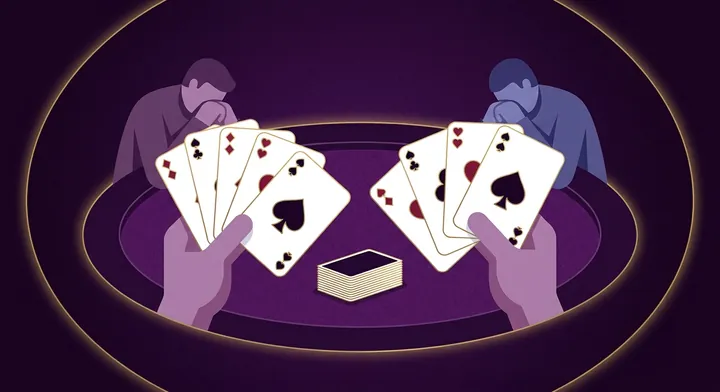
Goal
Duel a single opponent over thirteen tricks. Build your hand, bid the tricks you can win, and be the first to reach the target score with no partner to help.
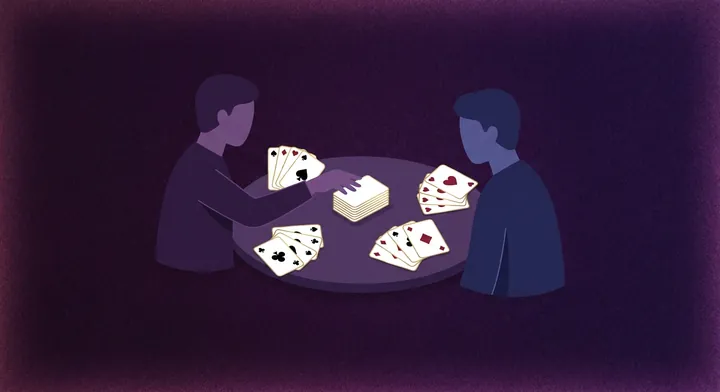
The draw
In the classic version, players alternate drawing the top card of the stock, choosing to keep it or discard it and take the next, until each has assembled a thirteen-card hand. This draw phase is what makes two-handed play distinctive.

Bidding
Once both hands are set, each player bids the number of tricks they expect to win, from Nil upward. With only two hands in play, your opponent's bid is an unusually loud clue about what they hold.
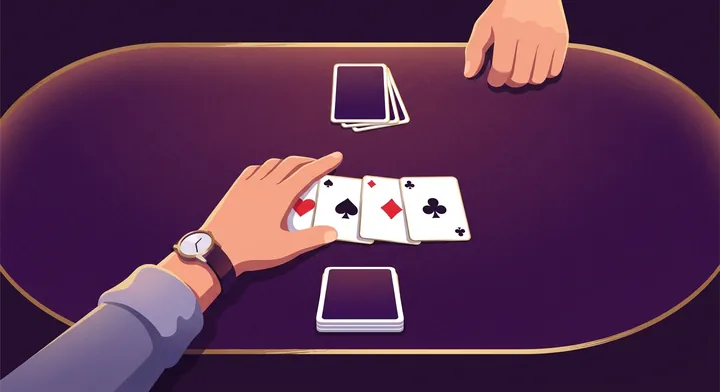
Play the tricks
Trick play is standard: follow suit, spades are trump and must be broken before being led, and the higher spade or higher led-suit card wins the trick and leads the next.
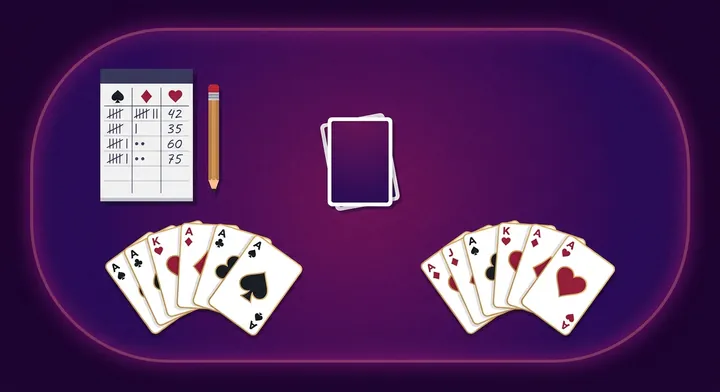
Scoring
Score ten points per trick bid when you make it, one per overtrick bag, minus ten per trick when set, and take the 100-point penalty for every ten bags - Just as in the four-player game.
Where 2-Hand comes from
Two-handed Spades arose from the simple desire to play the game with just one other person. Since a straight deal of thirteen each leaves half the deck unused and unknown, players borrowed a draw mechanic from other two-handed card games, letting each player build a hand from the stock and injecting both choice and information into the setup.
That draw phase gave the two-player game its defining character as a duel of deduction. With so much of the deck passing through the draw and only one opponent to track, card counting became the dominant skill, and the format earned a reputation as the most cerebral way to play Spades.
Though less common than the four-player classic, two-handed Spades has a devoted following among couples, roommates and anyone who wants a serious card game for two. It proves that the essential pleasures of Spades - Bidding, trumps and the sandbag squeeze - Survive intact even when the table shrinks to a single pair of rivals.
Winning 2-Hand: bidding & play
♠ Table wisdom: Count cards relentlessly. With only one opponent and so much of the deck seen, tracking exactly which high cards and spades remain is the single most powerful skill in two-handed play.
The tips that move the score the most
- Use the draw to shape a plan. When building your hand, favor a strong, controllable suit and enough spades to fight the trump war, rather than grabbing random high cards.
- Read your opponent's bid precisely. In a two-hand game their number reveals a great deal about their spades and aces, so recalculate your own chances the instant they bid.
- Guard trump control above all. With no partner, whoever commands the spades commands the endgame, so hang on to a boss trump to seize the final, decisive tricks.
- Bid Nil only with a truly safe hand. There is no cover at all in a duel, so a Nil must be built from low cards you can duck every single time your opponent leads.
- Force unwanted tricks onto your rival. Leading low into a suit where they hold an awkward high card is how you set their bid or bust their Nil in a one-on-one game.
- Track the bag count between just the two of you. In a duel the sandbag penalty is a real weapon - Sometimes you deliberately overtrick your opponent toward their own 100-point hit.
Advanced 2-Hand tactics
- Make card counting your central discipline, because with only twenty-six cards in play and a revealing draw, the player who most accurately reconstructs the opponent's hand controls the duel.
- Treat the draw as your first strategic decision, shaping a hand with genuine trump control and one strong, long side suit rather than a scattershot collection of unsupported high cards.
- Decode your opponent's bid as a near-transparent signal, since in a two-hand game their number narrows their possible spades and aces dramatically and should immediately revise your own plan.
- Fight for and preserve trump supremacy, because in a partnerless duel the holder of the last boss spade dictates the endgame, and surrendering trump control usually means surrendering the hand.
- Attempt Nil only from a hand that can duck every lead, recognizing that a lone opponent with no distractions will hammer your zero from the first trick and that you have no cover at all.
- Engineer forced tricks onto your rival by leading low into their awkward high cards, the two-hand way to manufacture a set or bust a Nil without any partner's assistance.
- Wield the sandbag rule as a two-way weapon, sometimes deliberately feeding your opponent overtricks to push them toward their own 100-point penalty while you keep your own bag count clean.
2-Hand mistakes that cost you points
- Neglecting to count cards - With only one opponent and half the deck seen, tracking the remaining spades and high cards is the single strongest skill in the duel.
- Drawing for random high cards - Build your hand toward trump control and one strong side suit, not a scattered fistful of unsupported aces.
- Surrendering trump control - Whoever holds the last boss spade dictates the endgame, so guard your high trumps in a partnerless duel.
- Going Nil on a risky hand - There is no cover at all one-on-one, so a Nil must be built from low cards you can duck on every single lead.
Ways to play 2-Hand
Draw vs straight deal
The classic two-hand game uses a draw from the stock to build each hand, but many casual players simply deal thirteen cards each. The draw adds choice and information; the straight deal is quicker but reveals less.
Target 250 or 500
As in the four-player game, duels can run to a brisk 250 or the traditional 500. The shorter target keeps a two-player session tight, while 500 lets superior counting grind out a win over many hands.
Nil-optional duels
Because a Nil is so exposed in a duel, some pairs agree to bar it entirely, turning the game into a pure contest of positive bidding and trump control.
Honeymoon Spades
A nickname for the draw-based two-handed game, reflecting its popularity as a serious card game for two players who want more depth than a simple dealt hand provides.
Four-player Partnership Spades
The full classic from which the two-hand duel is distilled - Add two more players and fixed partnerships for the social, team-based version of the same core game.
2-Hand questions, answered
How do you deal 2-player Spades?
The traditional method uses a draw: players alternate taking the top card of the stock, keeping it or discarding it and drawing the next, until each has built a thirteen-card hand. Some casual versions simply deal thirteen cards to each player instead, skipping the draw.
What is the draw phase in two-handed Spades?
It is the hand-building stage unique to the two-player game. Rather than being dealt a fixed hand, you and your opponent take turns drawing from the stock and deciding what to keep, which lets you shape your hand and reveals information about the deck.
Is 2-player Spades a game of skill?
Very much so. With only one opponent and much of the deck visible through the draw and play, card counting and deduction dominate. There is no partner and no extra players to add noise, so nearly everything comes down to reading the single hand across from you.
Can you bid Nil in two-handed Spades?
Yes, and it is played the same way - A promise to win no tricks for a bonus, busted by winning even one. But it is risky, because there is no partner to cover you and your lone opponent is free to attack your zero from the first lead.
Do spades have to be broken in the two-player game?
Yes. The trump rule carries over: you cannot lead a spade to a new trick until spades are broken by an off-suit play, or until spades are all you hold. In a duel, timing that first spade correctly is especially important.
How is 2-player Spades scored?
Exactly like the standard game: ten points per trick bid when you make it, one point per overtrick bag, minus ten per trick when set, and a 100-point penalty for every ten bags. The first player to the target score wins the duel.
How many tricks are in a two-handed hand?
Thirteen, once both players have built or been dealt a thirteen-card hand. Only twenty-six cards are in play at once, so a large portion of the deck is either in the stock or discarded, which is what makes counting so effective.
Why is card counting so strong in two-handed Spades?
Because there is only one other hand to deduce, and the draw and discards reveal so much of the deck. As cards are played you can often reconstruct your opponent's exact holding, turning the endgame into a near-perfect-information puzzle.
Is there a partner in 2-player Spades?
No. It is a pure one-on-one duel with no partnerships, so there is no one to cover your Nil or absorb your overtricks. Every decision and every consequence is entirely your own.
What is the best strategy for the draw?
Build toward trump control and a strong side suit rather than hoarding random high cards. A hand with enough spades to win the trump war and a reliable long suit is far more useful in a duel than a scattered fistful of aces.
What target score should we use?
Two-handed games commonly play to 250 or 500, just like the four-player version. Because scoring is between only two players, a target of 250 keeps duels tight while 500 rewards sustained accuracy over many hands.
Is 2-player Spades harder than the four-player game?
It is harder in the sense that it rewards memory and precise deduction more heavily, since there is so little hidden and no partner to lean on. Players who enjoy card counting often consider it the most skill-intensive way to play Spades.
Keep learning 2-Hand
Still puzzling over 2-Player Spades? Read the full Spades FAQ, look up a term like nil or bag in the Spades glossary, or compare 2-Hand with every other version in the complete rules of Spades.
Last reviewed .