Mirror Spades, where your spades set the bid
Your bid is your spade count - Always. The cards decide, the play is all that remains.Deal in for a full match of Mirror Spades right in your browser - four players in two partnerships, every bid forced, played against opponents who bid and defend like real players. Nothing to download, no account needed: the table below is live, so take a seat and start bidding.
How Mirror Spades works
The short version: Your bid is your spade count - Always. The cards decide, the play is all that remains. You play with four players in two partnerships, every bid forced, using one standard 52-card deck, dealt thirteen to a hand, and it is pure card play - no bidding decisions at all.
Mirror, sometimes called Mirrors, takes the forced-bid idea to its logical extreme. Your bid is always, without exception, the exact number of spades in your hand. There is no Nil escape and no judgment: deal seven spades and you bid seven; deal zero and you bid zero. The bid quite literally mirrors your trump holding, which is where the name comes from. With bidding reduced to simple arithmetic, Mirror becomes the most play-driven member of the Spades family. Every hand starts from a known, unavoidable contract, and the entire game is about squeezing your forced number out of the cards - Winning exactly the spades you were dealt, no more and no less, while your opponents try to knock you off that razor's edge. It is a favorite of players who love pure trick-taking without a whiff of bidding luck.
Mirror at the table
| Object of the game | Win exactly as many tricks as you were dealt spades. There are no bidding choices - Your contract is fixed the moment the cards are in your hand, and the first team to the target score wins. |
|---|---|
| Players | Four players in two partnerships, every bid forced |
| Cards | One standard 52-card deck, dealt thirteen to a hand |
| How you win the match | First partnership to reach the target score wins |
| Luck vs skill | High - The bid is automatic, so every point comes from the play |
| Family | Nil Variants |
A hand of Mirror, step by step
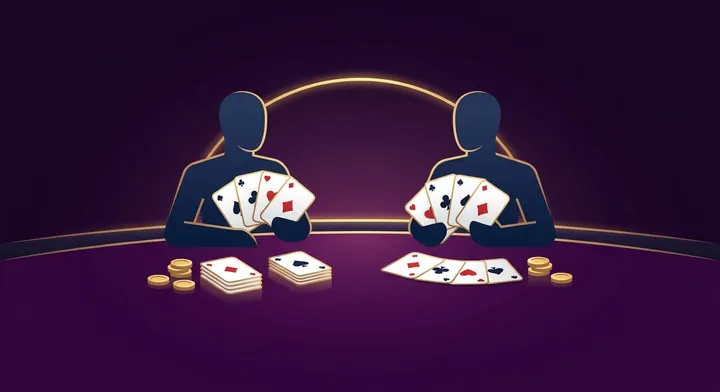
Goal
Win exactly as many tricks as you were dealt spades. There are no bidding choices - Your contract is fixed the moment the cards are in your hand, and the first team to the target score wins.
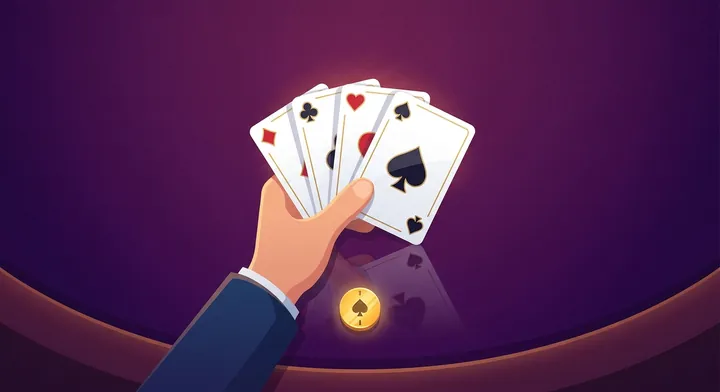
The forced bid
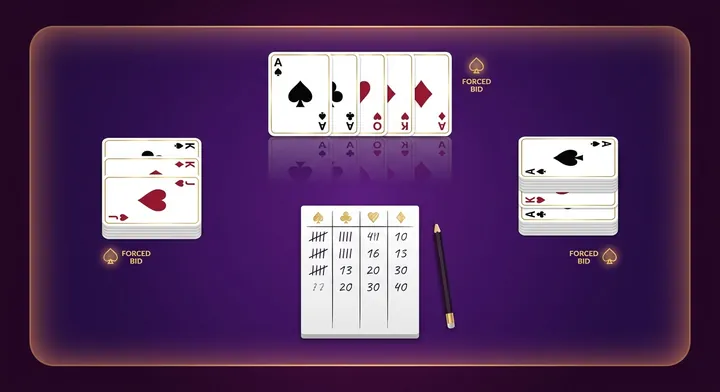
Count your spades. That number is your bid, every hand, with no Nil option. A hand with three spades is a bid of three; a hand with zero spades is a bid of zero, meaning you must take no tricks.
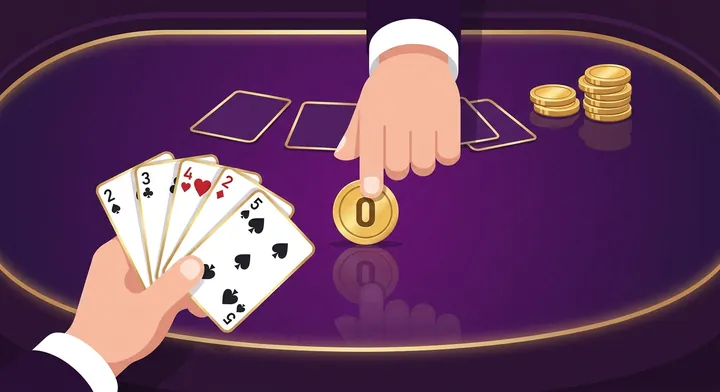
When you must go nil
If you are dealt no spades at all, your forced bid of zero works exactly like a Nil - You must avoid winning a single trick, and your partner will try to cover you as usual.
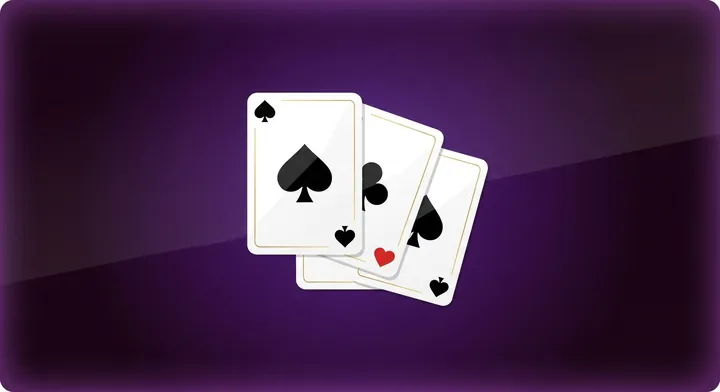
Following suit
Play is standard: follow the led suit if you can, spades are trump and must be broken before being led, and the strongest spade or led-suit card wins each trick.
Scoring
Scoring is ordinary Spades. Make your combined forced bid for ten points per trick plus overtrick bags, get set for minus ten per trick, and take the 100-point hit for every ten bags.
Where Mirror comes from
Mirror grew up alongside Whiz in the competitive online Spades scene as an even purer forced-bid format. Where Whiz still granted the Nil escape, Mirror stripped it away, insisting that the bid always equal the spade count and turning the game into a contest of nothing but card play.
The format found its audience among serious players who wanted to eliminate every trace of bidding luck. By making the contract a direct reflection of the hand, Mirror ensured that two skilled teams faced identical bidding constraints and that all the difference between them would show up in the play.
Today Mirror is a fixture of Spades apps and tournament rotations, often paired with Whiz and Suicide as the trio of forced-bid variants. It is prized as the format where the cards, and only the cards, decide the outcome.
Winning Mirror: bidding & play
♠ Table wisdom: Accept the number and plan the play. You cannot change a Mirror bid, so the instant you count your spades, start mapping exactly which tricks will make that total.
The tips that move the score the most
- A zero-spade hand is a mandatory Nil - Treat it as one. Shed your dangerous high cards early and lean on your partner to cover the tricks you must not win.
- Long-spade hands must draw trumps. If you are forced to bid six or seven, you have to actively win those spades, so pull the opponents' trumps before they can ruff your winners.
- Convert the whole table's bids into a spade census. Because every bid equals a spade count, you know precisely how the trumps are split before a single card is played.
- Protect a partner stuck on an awkward count. If your partner was forced into a fragile two- or three-spade bid, use your own cards to shore up exactly those tricks.
- Duck relentlessly on a low forced bid. When your number is one or two, avoid winning early tricks so you do not overshoot into bags or blow past a bid you cannot raise.
- Watch overtricks even harder than usual. Since you cannot pad your bid to match a strong hand, extra winners you cannot avoid pile up as bags, so plan to lose the ones you do not need.
Advanced Mirror tactics
- Turn the opening bids into a complete spade distribution, since every player's bid is their exact trump count; from that census you can plan the whole hand's trump warfare before the first lead.
- On a long forced bid, commit immediately to drawing the opponents' trumps, because your inflated number can only be made by actively cashing spades and denying opponents the chance to ruff.
- Treat a zero-spade hand as a full Nil and start discarding your most dangerous cards from the first safe trick, coordinating with your partner exactly as you would to protect an ordinary Nil.
- On a small forced bid, duck early and often, aiming to win precisely your number late in the hand when you can control which tricks you take rather than being handed them.
- Continuously separate 'tricks I must win' from 'tricks I must avoid', because the fixed contract means every unnecessary winner is a bag and every missed target trick is a step toward a set.
- Shore up a partner trapped on an awkward count by taking over the suits their fragile bid depends on, spending your own controllable cards where their forced number is most at risk.
- Plan overtrick disposal in advance; with no ability to raise your bid to match a big hand, you must deliberately lose the surplus tricks or watch them pile into a 100-point sandbag penalty.
Mirror mistakes that cost you points
- Trying to change a bid you cannot change - The number is your exact spade count, so stop wishing and immediately plan the precise tricks that hit it.
- Treating a zero-spade hand casually - A forced zero is a mandatory Nil, so discard your dangerous high cards early and let your partner cover you.
- Passively holding a long forced bid - A six or seven must be actively won, so draw the opponents' trumps before they can ruff your winners.
- Overshooting a small forced bid - When your number is one or two, duck early tricks so you do not pile up bags or blow past a total you cannot raise.
Ways to play Mirror
Mirror with a Nil option
Some casual tables soften Mirror by allowing a Nil bid as an alternative to the spade count, which effectively turns it back into Whiz - A common house compromise for mixed-skill groups.
Solo Mirror
Played cutthroat, each lone player bids their exact spade count with no partner to help, producing an intensely play-focused four-way battle with zero bidding choices.
Whiz
The nearest relative, identical except that Whiz permits a Nil bid instead of the forced spade count, giving players one meaningful decision that Mirror denies them.
Blind Mirror
A rare, aggressive twist where a trailing team may commit to their forced bid before looking at their cards, layering a gamble onto the otherwise deterministic format.
Suicide
Another forced-bid cousin, but one that forces a Nil rather than a spade count, requiring one partner of each team to promise zero tricks every hand.
Mirror questions, answered
How is Mirror different from Whiz?
Both force your bid to equal your spade count, but Whiz lets you bid Nil instead. Mirror removes that escape entirely: your bid is always exactly your number of spades, with no option to promise zero unless you were actually dealt zero spades.
What happens if I have no spades in Mirror?
Then your forced bid is zero, which functions exactly like a Nil - You must win no tricks at all. It is the only way a Mirror bid becomes a zero, and it is played and covered just like a normal Nil.
Do I ever get to choose my bid in Mirror?
No. That is the entire point of the format. The bid is pure arithmetic - Count your spades and call the number - So the game has no bidding decisions whatsoever and lives or dies on the play of the cards.
Is Mirror harder than standard Spades?
It removes the hardest skill for many players, judging a bid, but it demands very precise card play, because you must hit an exact number you did not choose. Good players find it a stern test; casual players enjoy that the awkward bidding step is gone.
Why is it called Mirror?
Because your bid reflects your hand exactly - It mirrors the number of spades you hold. The contract is a direct image of your trump length, with nothing added and nothing subtracted.
How do you win a game of Mirror Spades?
You accumulate points hand by hand and race your partnership to the target score, just like the standard game. Making your forced contracts and dodging sets and bags is the whole path to the target.
Can I be set in Mirror?
Absolutely. If your team wins fewer combined tricks than your forced bids demand, you are set and lose ten points per trick bid. Because you cannot adjust the number to a safer figure, avoiding a set is entirely a matter of skillful play.
Does covering a partner still matter in Mirror?
Yes, especially when a partner is forced into a zero bid (a mandatory Nil) or an awkward small count. You use your own cards to win the tricks they must avoid or to shore up the exact tricks their forced bid requires.
Are bags still a thing in Mirror?
Yes. Every overtrick beyond your forced bid is a bag, and ten bags still cost 100 points. Because you cannot inflate your bid to match a strong hand, managing unwanted extra tricks is a constant concern.
Do spades have to be broken in Mirror?
Yes. As in every Spades variant, you cannot lead a spade to a new trick until spades are broken or you hold nothing else. The rule shapes how you develop the side suits that decide most Mirror hands.
Is Mirror good for beginners?
It can be, because it removes bid guessing, but it is unforgiving on the play since you must hit an exact target. Beginners learn a lot about trick-taking from Mirror, even if the fixed bids occasionally hand them a very tough hand.
What is the best strategy in Mirror Spades?
Read your forced number instantly, then plan the precise tricks that hit it - Drawing trumps on a long-spade hand, ducking on a short one, and treating a zero-spade hand as a Nil to be covered. Because bidding is automatic, all your effort goes into the play.
Keep learning Mirror
- Mirror Spades and the forced spade-count bid
- Bags and sandbags: the hidden Spades penalty
- Browse the full Spades FAQ
Still puzzling over Mirror Spades? Read the full Spades FAQ, look up a term like nil or bag in the Spades glossary, or compare Mirror with every other version in the complete rules of Spades.
Last reviewed .