Whiz Spades: bid your spades or go Nil
Bid the number of spades in your hand - Or go Nil. There is no third choice.Deal in for a full match of Whiz Spades right in your browser - four players in two partnerships, with a strict bidding rule, played against opponents who bid and defend like real players. Nothing to download, no account needed: the table below is live, so take a seat and start bidding.
How Whiz Spades works
The short version: Bid the number of spades in your hand - Or go Nil. There is no third choice. You play with four players in two partnerships, with a strict bidding rule, using one standard 52-card deck, dealt thirteen to a hand, and it is sharp - the bid is forced, the play is everything.
Whiz is Partnership Spades with the bidding decision taken out of your hands. The rule is brutally simple: you must bid exactly the number of spades you were dealt, or you must bid Nil. There is no rounding, no hedging and no judgment call - You count your spades and that is your bid, unless you choose to gamble everything on winning zero tricks instead. That single constraint transforms the game. Because everyone's positive bid is public information the moment they announce it (their spade count is their bid), the fog of the bidding phase lifts and the entire battle moves into the play of the cards. Whiz rewards players who can make the most of a bid they did not choose, squeezing tricks from short-spade hands and defending relentlessly against the Nils that a forced bid makes far more common.
Whiz at the table
| Object of the game | Play partnership Spades where the bid is dictated by your hand. You and your partner still combine your bids, and the first team to the target score wins. |
|---|---|
| Players | Four players in two partnerships, with a strict bidding rule |
| Cards | One standard 52-card deck, dealt thirteen to a hand |
| How you win the match | First partnership to reach the target score wins |
| Luck vs skill | High - With bidding removed, the whole contest is in the card play |
| Family | Nil Variants |
A hand of Whiz, step by step

Goal
Play partnership Spades where the bid is dictated by your hand. You and your partner still combine your bids, and the first team to the target score wins.

The Whiz bid
Count the spades in your hand - That number is your bid. Deal with six spades and you must bid six. The one escape is to declare Nil instead of bidding your spade count.

Nil in Whiz
Because you can always choose Nil rather than your spade count, players with few spades often go for zero. This makes Nils common, so covering your partner and busting the opponents' Nils is central to Whiz.

Play and trumps
Trick play is standard Spades: follow suit, spades are trump and must be broken before being led, and the highest spade or highest led-suit card wins each trick.
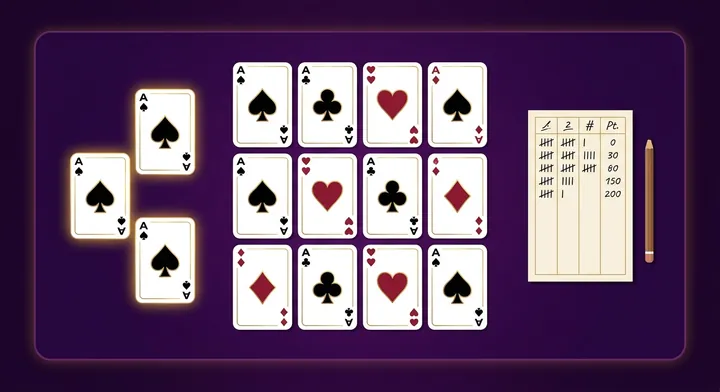
Scoring
Score exactly as in partnership Spades - Ten points per trick bid when you make the combined contract, plus overtrick bags, minus ten per trick when set, minus 100 for every ten bags.
Where Whiz comes from
Whiz emerged from the online and tournament Spades community as an answer to a common complaint about the standard game: that a lucky or shrewd bid could matter more than skillful play. By forcing every bid to equal the player's spade count, Whiz removes bidding judgment almost entirely and pushes the contest into the cards.
The format became a staple of competitive Spades ladders and card-room apps, where its transparency is prized. Since a positive bid always reveals a spade count, there is far less hidden information, and matches are decided by defense, timing and the handling of the many Nils that a forced bid encourages.
Whiz has since spread back into casual play as a beloved change of pace. Players who find standard bidding stressful enjoy having the decision made for them, while veterans appreciate that the game strips Spades down to its purest test of trick-taking and Nil warfare.
Winning Whiz: bidding & play
♠ Table wisdom: Decide Nil-or-count before you even sort your hand fully. With three or fewer spades and weak side suits, Nil is often safer than a small forced bid that opponents can easily attack.
The tips that move the score the most
- Respect a long-spade forced bid. If you are handed a seven-spade bid, plan to draw trumps and cash them, because you cannot lower the number to something comfortable.
- Assume Nils everywhere. The forced-bid rule makes low-spade hands bid Nil far more often, so from the first trick be ready to bust an opponent's zero or protect your partner's.
- Cover your partner's Nil with your spades. Since your own bid is fixed by your spade count, use those trumps deliberately to win the tricks your Nil-bidding partner must avoid.
- Read the table's spade math. Every positive bid is literally a spade count, so add them up to estimate how many trumps opponents hold and when they will run out.
- Duck to protect your own Nil aggressively. When you are the one who chose Nil, shed high and middle cards early while a teammate or opponent is safely winning the trick.
- Do not waste high spades on empty tricks. Your forced bid depends on those trumps scoring, so save them for tricks the opponents genuinely contest rather than throwing them at the first lead.
Advanced Whiz tactics
- Treat the Nil-or-count decision as the only bid you control, and weight it toward Nil whenever your spades are few and your side suits are riddled with low cards you can safely shed.
- When forced into a long-spade bid, plan a trump-drawing campaign from trick one, because you cannot shrink the number and must actively win those spades to avoid being set.
- Sum every announced positive bid to reconstruct the exact distribution of spades around the table, then use that map to predict when opponents will be void and forced to discard.
- Prioritize covering a partner's Nil over making marginal overtricks, since the forced-bid environment makes Nils both frequent and swingy, and a covered Nil is often the biggest score in the hand.
- Against an opponent's Nil, coordinate low leads across two suits so their safe cards run dry, remembering that with forced bids you can often infer exactly which suits they are thin in.
- Bank your high spades for contested tricks, because your entire forced bid rests on those trumps converting, and squandering the ace or king early can turn a made bid into a set.
- Play the bag count carefully even though you did not choose your bid; a forced small bid that keeps winning extra tricks can quietly march your team toward the 100-point sandbag penalty.
Whiz mistakes that cost you points
- Bidding your spade count on a weak short-spade hand - With three or fewer spades and low side cards, Nil is usually the safer forced choice than a fragile small bid.
- Forgetting that every positive bid is a spade count - Add up the announced bids to map the trumps, because that information is the whole point of the format.
- Being surprised by frequent Nils - The forced bid makes zeros common, so plan from trick one to cover your partner's Nil and attack the opponents'.
- Wasting high spades early on a forced long bid - Your bid can only be made if those trumps score, so hold them for the tricks the opponents actually contest.
Ways to play Whiz
Whiz with Blind Nil
Some tables keep Blind Nil available as an alternative to the forced count for teams that are far behind, layering a double-or-nothing gamble on top of the forced-bid framework.
Solo Whiz
Played cutthroat, each lone player must bid their spade count or Nil, which combines the transparency of Whiz with the shifting alliances of Solo for an especially sharp game.
Mirror
A close cousin that also forces the bid to the spade count but removes the Nil escape hatch entirely, so you must always bid exactly how many spades you hold.
Must-cover Nil rules
Variants that require the partner of a Nil bidder to take specific actions, formalizing the covering duty that Whiz already makes so central.
Suicide-Whiz hybrids
House formats that blend Whiz's forced count with Suicide's forced Nil, demanding that one partner go Nil while the other bids their spade count.
Whiz questions, answered
What exactly is the Whiz bidding rule?
On every hand you must bid the exact number of spades you were dealt, or bid Nil instead. Those are your only two options - You cannot bid a rounded or judgment number. If you hold five spades, your choices are 'five' or 'Nil'.
Why would anyone bid Nil in Whiz instead of their spade count?
When you are dealt very few spades, your forced positive bid would be tiny and easy for opponents to attack, and your low cards are ideal for ducking tricks. Nil turns that weak hand into a 100-point opportunity, which is why Whiz produces so many Nils.
Does my partner see my spade count?
Effectively yes - Announcing your bid reveals your spade count to everyone, since the bid must equal it. That shared information is what shifts Whiz away from bidding guesswork and into a pure contest of card play and defense.
What if I only have one or two spades?
You may bid that small number, but many players choose Nil instead, because a one- or two-trick forced bid is fragile and your low spades are perfect for dodging tricks. The decision hinges on your side suits and how safely you can avoid winning.
Is Whiz a partnership game?
Yes. Whiz is standard Partnership Spades with the single change that bids are forced. Partners still combine their bids into one contract, still cover each other's Nils, and still race to a shared target score.
How does scoring work in Whiz?
Identically to partnership Spades. You score ten points per trick in your combined bid when you make it, one point per overtrick bag, minus ten per trick when set, and the usual 100-point penalty for every ten bags accumulated.
Does the forced bid make the game easier?
It removes the bidding-judgment part of the game but makes the card play harder and more important. Because everyone's positive bid is public and Nils are frequent, precise defense and trump management carry far more weight than in the standard game.
Can I bid zero spades if I have no spades?
If you are dealt no spades your forced count is zero, which is effectively a Nil - You are promising to win no tricks. A spade-void hand is a natural, strong Nil candidate because you have no trumps that might accidentally win a trick.
How do I beat an opponent's Nil in Whiz?
Lead low cards in suits where the Nil bidder holds a middling card, forcing them to eventually win a trick. Because Whiz produces so many Nils, having a plan to attack them from the first trick is one of the most valuable skills in the format.
Do spades still have to be broken in Whiz?
Yes, the trump rules are unchanged. You cannot lead a spade until spades are broken by someone playing one when off-suit, or until you hold only spades. That rule matters even more when so many hands hinge on protecting or busting a Nil.
Why is it called Whiz?
The name reflects how quickly the bidding goes - There is no deliberation, you simply count your spades and call the number. With the slow part of Spades removed, the game 'whizzes' straight into the play.
Is Whiz good for new players?
In one sense yes, because it removes the hardest skill for beginners - Judging a bid. But it also raises the stakes on the card play and on handling frequent Nils, so it is best thought of as a game that teaches sharp play rather than gentle practice.
Keep learning Whiz
- What is Whiz Spades? The forced-bid rule
- Nil in Spades: how the zero bid works
- Browse the full Spades FAQ
Still puzzling over Whiz Spades? Read the full Spades FAQ, look up a term like nil or bag in the Spades glossary, or compare Whiz with every other version in the complete rules of Spades.
Last reviewed .