Solo Spades, every player for themselves
Cutthroat, every player for themselves - No partner to save you, and no one you owe.Deal in for a full match of Solo Spades right in your browser - four players, each bidding and scoring alone - no teams, played against opponents who bid and defend like real players. Nothing to download, no account needed: the table below is live, so take a seat and start bidding.
How Solo Spades works
The short version: Cutthroat, every player for themselves - No partner to save you, and no one you owe. You play with four players, each bidding and scoring alone - no teams, using one standard 52-card deck, dealt thirteen to a hand, and it is cutthroat and tactical.
Solo Spades, often called Cutthroat, strips away the partnerships and leaves four players fighting for themselves. The deal, the trump rule and the trick-taking are identical to the partnership game, but the psychology could not be more different. Nobody is obligated to help you make your bid, and nobody owes you a trick. Every hand is a three-way war of shifting, temporary alliances. Because there is no partner to cover a Nil or soak up your overtricks, the bidding becomes far more personal. A player who bids Nil is fair game for the whole table, and a leader running away with the match will suddenly find the other three quietly cooperating to set them. Solo rewards players who can read the room as well as the cards - Knowing when to press, when to hide, and when to let a rival hang themselves on an ambitious bid.
Solo at the table
| Object of the game | Play only for yourself. Each hand you bid the tricks you can win with no partner to help, and the first player to reach the target score takes the whole game. |
|---|---|
| Players | Four players, each bidding and scoring alone - No teams |
| Cards | One standard 52-card deck, dealt thirteen to a hand |
| How you win the match | First player to reach the target score wins |
| Score targets | Quick to 200, Standard to 300 |
| Luck vs skill | Very high - Table politics and reading three opponents matter as much as the cards |
| Family | Classic |
A hand of Solo, step by step
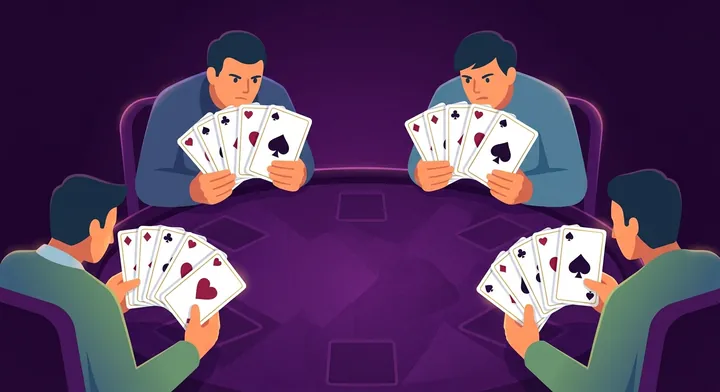
Goal
Play only for yourself. Each hand you bid the tricks you can win with no partner to help, and the first player to reach the target score takes the whole game.

The deal
As in the partnership game, the full deck is dealt out thirteen cards to each of the four players. Everyone keeps their own separate score from the first hand to the last.

Bid for yourself
Beginning left of the dealer, each player bids the number of tricks they alone expect to win. There is no team total - You are judged on your personal bid every single hand.

Follow suit or trump
Follow the led suit when you can. Spades are trump and cannot be led until broken. The highest spade, or the highest card of the led suit if no spade appears, wins the trick.

Scoring
Score ten times your bid when you make it exactly, plus one point per overtrick bag. Fall short and you are set for ten points a trick. Bags still bite: ten of them cost you 100 points.
Where Solo comes from
Solo, or Cutthroat, Spades is as old as the partnership game itself and arose from the same practical need: not every table has an even four players who want to pair off. Removing the partnerships let any four people sit down and play, and the version quickly developed its own devoted following.
Where partnership Spades became famous for the bond between teammates, Solo became famous for the opposite - Its ruthless, everyone-for-themselves politics. The absence of a partner changed the game's character entirely, elevating table talk, temporary alliances and the art of ganging up on the leader into core skills rather than sideshows.
Solo play thrives especially in casual and online settings, where players drop in and out and fixed partnerships are impractical. It remains the definitive way to play Spades with an odd social dynamic in mind, and many players consider it the purer test of individual skill precisely because there is no partner to share the blame or the glory.
Winning Solo: bidding & play
♠ Table wisdom: Bid a touch conservatively. With no partner to absorb a trick you cannot avoid, an ambitious bid is easy for three opponents to attack, so bank the tricks you are sure of.
The tips that move the score the most
- Never help the leader. If one player is close to winning the game, throw your play behind whoever is best placed to set them - Cooperation is temporary but essential in cutthroat.
- Punish a lone Nil hard. A Nil with no partner to cover it is the juiciest target at the table; lead low and force the bidder to win a trick they desperately do not want.
- Keep an exit card in every suit. Because you alone must dodge unwanted tricks, hang on to a low card in each suit for as long as you can so you are never forced to win.
- Let rivals overreach. When another player makes a greedy bid, you often score more by quietly denying them one trick than by grabbing overtricks that only fatten your own bag pile.
- Time your spades for yourself. There is no partner who benefits from your trumps, so spend them purely to make your own bid and to sabotage the player you most need to stop.
- Hide your hand's strength. In solo the whole table watches your discards; disguise a strong suit so opponents do not gang up to strip your winners before you can cash them.
Advanced Solo tactics
- Model three separate opponents, not one field. Track each rival's bid, their likely voids and how close they are to the target, because the right play against the leader is often the wrong play against a straggler.
- Weaponize the lead against the current front-runner. Leading suits they must trump, or forcing them to win unwanted tricks, is how a lone player engineers a set without a partner's help.
- Guard your escape cards jealously. In Solo you have no partner to eat a trick you cannot dodge, so retaining a low card in each suit is the difference between hitting your bid and drowning in bags.
- Bluff your bid with your early plays. Since everyone watches your discards, occasionally dumping from a strong suit early can convince the table you are weak there and stop them from stripping it.
- Attack a Solo Nil from multiple suits at once. With three defenders instead of one, coordinate low leads across suits so the Nil bidder runs out of safe cards and is forced to win.
- Count the bag pressure on every player, including yourself. Late in a hand, whether to grab or shed a loose trick depends entirely on who is nearest the 100-point sandbag cliff.
- Play the score, not just the hand. When you are far ahead, take a safe bid and coast; when you are behind, look for the one hand where an aggressive Nil or a big contract can leapfrog the whole table.
Solo mistakes that cost you points
- Bidding as if you had a partner - In cutthroat no one covers you, so bank only the sure tricks and resist the ambitious number three opponents can gang up to break.
- Helping the table leader - Never hand a trick to the player about to win the game; throw your support behind whoever can set them instead.
- Leaving a lone Nil undefended in your own hand - Without a partner you must protect your zero yourself, so keep only low, duckable cards when you go Nil.
- Cashing overtricks for pride - Extra tricks only fatten your own bag pile toward the 100-point penalty, so shed the ones that do not make your bid.
Ways to play Solo
Target 200 vs 300
A shorter game to 200 keeps things brisk and swingy, while 300 gives skill more room to tell over a longer run of hands. Because a single player scores slowly, Solo targets sit well below the partnership standard of 500.
Whiz and Mirror solo
The forced-bid formats can be played cutthroat too, requiring each lone player to bid their exact spade count or the number of spades in hand, which removes bidding judgment and sharpens the card play.
Three-handed Cutthroat
With only three players, the deck is trimmed and everyone plays solo by necessity - The natural extension of Solo Spades to a smaller table.
Screw-the-dealer style scoring
Some house rules add extra penalties or bonuses to sharpen the cutthroat edge, such as steeper bag penalties that punish the greedy overtrick-grabbing that Solo tends to encourage.
No-Nil cutthroat
Because a lone Nil is so exposed, some tables ban Nil entirely in Solo, turning the game into a pure contest of accurate positive bidding and trump control.
Solo questions, answered
How is Solo Spades different from Partnership Spades?
The rules of the deal, trump and trick-taking are the same, but there are no teams. Every player bids and scores individually, so no one is obligated to help you make your contract or protect your Nil. It turns the game into a shifting three-way battle.
How many players do you need for Solo Spades?
Four, exactly as in the partnership game, but each of the four is an island. All thirteen tricks are contested by four separate interests, which makes the politics of who to help and who to hurt the heart of the game.
Why is it called Cutthroat?
Because there are no allies. In partnership play you always have someone covering your back, but in Solo every other player is a rival, and they will happily cooperate for a single hand purely to set you. The name captures that everyone-for-themselves tension.
What is the target score in Solo Spades?
It is usually lower than partnership Spades because a single player scores more slowly than a team of two. Common targets are 200 or 300 points, and on this site you can choose either. The first player to reach the target wins outright.
Is Nil harder in Solo Spades?
Much harder. In partnership play your partner actively covers your Nil by winning tricks you cannot, but in Solo you are on your own, and all three opponents will work together to force a trick onto you. A Solo Nil is a bold, high-risk play.
Can opponents team up against me in Solo?
There are no formal teams, but informal, temporary cooperation is not only allowed - It is the essence of cutthroat. If you are winning, expect the other three to quietly coordinate their leads and discards to knock you off your bid.
Do spades still have to be broken in Solo?
Yes. The trump rules are identical: you cannot lead a spade to a new trick until spades have been broken by someone playing one when unable to follow suit, or until spades are all you have left. That rule shapes the opening of every hand.
How do bags work when there is no partner?
Bags are still the overtricks you win beyond your own bid, and they still accumulate against you personally. Reach ten bags and you lose 100 points. Without a partner to hand spare tricks to, dodging overtricks in Solo takes even more care.
What is the best bidding strategy in Solo Spades?
Bid what you can win without help and resist padding the number. Because three opponents can gang up on an ambitious bid, the sure tricks - High spades and aces - Are worth more than speculative length that a partner might otherwise have supported.
Should I ever help another player in Solo?
Only when it serves you. The classic move is to help set the current leader so no single rival runs away with the match. Beyond that, every trick you give away is a trick that could have been yours, so 'help' is always self-interested.
How many tricks should I usually bid in Solo?
With thirteen tricks split four ways, an average hand is worth about three, so many hands fall in the two-to-four range. Adjust up for a fistful of high spades and aces, and down for a flat hand with no trump control.
Is Solo Spades harder than the partnership game?
It is harder to master because you cannot rely on anyone. In partnership play a mistake can be rescued by a good partner; in Solo every misjudged bid or careless discard is yours alone to pay for, and the whole table is motivated to exploit it.
Keep learning Solo
- Solo (Cutthroat) Spades explained
- How to win at Spades: a full strategy guide
- Browse the full Spades FAQ
Still puzzling over Solo Spades? Read the full Spades FAQ, look up a term like nil or bag in the Spades glossary, or compare Solo with every other version in the complete rules of Spades.
Last reviewed .